Web cookies (also called HTTP cookies, browser cookies, or simply cookies) are small pieces of data that websites store on your device (computer, phone, etc.) through your web browser. They are used to remember information about you and your interactions with the site.
Purpose of Cookies:
Session Management:
Keeping you logged in
Remembering items in a shopping cart
Saving language or theme preferences
Personalization:
Tailoring content or ads based on your previous activity
Tracking & Analytics:
Monitoring browsing behavior for analytics or marketing purposes
Types of Cookies:
Session Cookies:
Temporary; deleted when you close your browser
Used for things like keeping you logged in during a single session
Persistent Cookies:
Stored on your device until they expire or are manually deleted
Used for remembering login credentials, settings, etc.
First-Party Cookies:
Set by the website you're visiting directly
Third-Party Cookies:
Set by other domains (usually advertisers) embedded in the website
Commonly used for tracking across multiple sites
Authentication cookies are a special type of web cookie used to identify and verify a user after they log in to a website or web application.
What They Do:
Once you log in to a site, the server creates an authentication cookie and sends it to your browser. This cookie:
Proves to the website that you're logged in
Prevents you from having to log in again on every page you visit
Can persist across sessions if you select "Remember me"
What's Inside an Authentication Cookie?
Typically, it contains:
A unique session ID (not your actual password)
Optional metadata (e.g., expiration time, security flags)
Analytics cookies are cookies used to collect data about how visitors interact with a website. Their primary purpose is to help website owners understand and improve user experience by analyzing things like:
How users navigate the site
Which pages are most/least visited
How long users stay on each page
What device, browser, or location the user is from
What They Track:
Some examples of data analytics cookies may collect:
Page views and time spent on pages
Click paths (how users move from page to page)
Bounce rate (users who leave without interacting)
User demographics (location, language, device)
Referring websites (how users arrived at the site)
Here’s how you can disable cookies in common browsers:
1. Google Chrome
Open Chrome and click the three vertical dots in the top-right corner.
Go to Settings > Privacy and security > Cookies and other site data.
Choose your preferred option:
Block all cookies (not recommended, can break most websites).
Block third-party cookies (can block ads and tracking cookies).
2. Mozilla Firefox
Open Firefox and click the three horizontal lines in the top-right corner.
Go to Settings > Privacy & Security.
Under the Enhanced Tracking Protection section, choose Strict to block most cookies or Custom to manually choose which cookies to block.
3. Safari
Open Safari and click Safari in the top-left corner of the screen.
Go to Preferences > Privacy.
Check Block all cookies to stop all cookies, or select options to block third-party cookies.
4. Microsoft Edge
Open Edge and click the three horizontal dots in the top-right corner.
Go to Settings > Privacy, search, and services > Cookies and site permissions.
Select your cookie settings from there, including blocking all cookies or blocking third-party cookies.
5. On Mobile (iOS/Android)
For Safari on iOS: Go to Settings > Safari > Privacy & Security > Block All Cookies.
For Chrome on Android: Open the app, tap the three dots, go to Settings > Privacy and security > Cookies.
Be Aware:
Disabling cookies can make your online experience more difficult. Some websites may not load properly, or you may be logged out frequently. Also, certain features may not work as expected.
Reviewer Katie Roiphe calls the book a “lively, stylish social history” and remarks on the fact that the book faces the “divisions and power struggles at the heart of the women’s liberation movement” rather than treating it as a cohesive effort.
In For Your Health and Ours: An Eastern European History of Global Health, Sara Silverstein uses new research and material in six languages from seven countries and twenty-seven archives to describe a history of global health that decenters imperial influence and emphasizes the initiatives of people on the political peripheries including in the Global South.
“The Minutemen and Their World” celebrated 50 years as America celebrated its 250th this year. The book is a Bancroft Prize winner and has remained integral to understanding what the American Revolution was like for the people of Concord, Massachusetts as they navigated day to day life leading up to and in the midst of a war against the British. Gross himself lives in Concord and this connection to the first battleground of the revolution and other iconic moments in early American history was one of the factors that led to his book taking shape the way it did. By focusing on people and stories it was an early and unshakable example of writing history for more general audiences and making history accessible to a wide audience without watering it down.
Dr. Jeffrey Ogbar is a Professor of History with the College of Liberal Arts and Sciences and Founding Director of the Center for the Study of Popular Music. He joined the UConn History Department in 1997. Dr. Ogbar is a scholar of African American history and Black social movements, and his teaching and graduate advising have supported numerous students in developing their understanding and research of social movements, race, and music in American history and the present. He has authored four monographs, the latest of which, Land of Our Own: Malcolm X and the Evolution of Black Nationalism, is being released later this year.
Read more about the 2025-2026 Board of Trustees Distinguished Professors here.
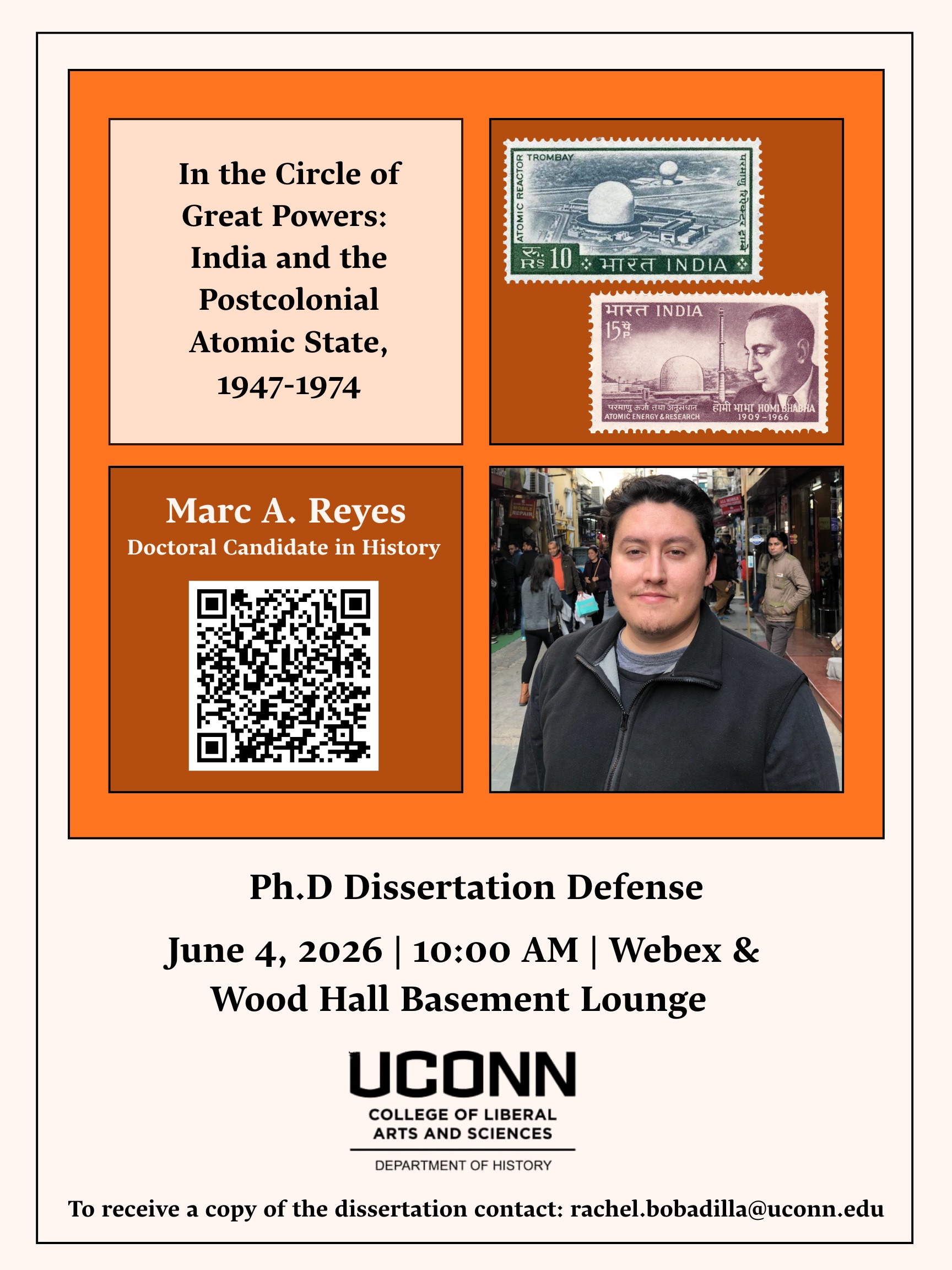
On June 4th, Marc Reyes successfully defended his dissertation, “In the Circle of Great Powers: India and the Postcolonial Atomic State, 1947-1974.” Next, he will begin a postdoctoral fellowship at Stanford University’s Center for International Security and Cooperation (CISAC). During his appointment, Marc will present his research at CISAC weekly seminars, revise his dissertation chapters into journal articles, and participate in the fellows’ policy workshops and simulations.
From Marc’s dissertation abstract:
This dissertation examines the diplomatic, political, and intellectual history of India’s atomic energy program, using its research of the atom as a lens to better understand the country’s thinking and actions during the Cold War and beyond. It sheds light on how Indians, from public officials to security strategists to academics, preached the necessity of atomic energy’s peaceful uses while also issuing ambiguous statements regarding the development of nuclear weapons. Incorporating sources from multiple countries and over a dozen archives and libraries, the project views India’s atomic energy program as a transnational project shaped by Indian and non-Indian actors. The study concludes that India’s pursuit of the bomb went beyond scientific prestige and recognition as a modern state. After India’s decisive victory over Pakistan in a 1971 war, Indian leaders, such as prime minister Indira Gandhi, embraced the concept of an Indian bomb. Upon its 1974 “peaceful nuclear explosion,” Gandhi believed her country now had the mettle to stand in line with the world’s great powers.
Congratulations Dr. Marc Reyes on these impressive achievements!
Professor Sinha will give a talk on the exhibit and her work as a Reconstruction Historian on June 4th at a special preview of “The Second American Revolution”. The exhibit will be open from June 5 through January 17 and explores the Reconstruction era’s early efforts to give newly freed and free Black Americans full citizenship and rights, and the ways in which this mission was largely eroded leaving America with consequences that have followed the nation into the 21st century.
You can read more about this exhibit on the Abraham Lincoln Presidential Library and Museum website here:
The article is entitled “The Civil Rights Era is Collapsing Before Our Eyes,” By Nikole Hannah-Jones, and appeared in both the print and online versions of The New York Times May 22, 2026.
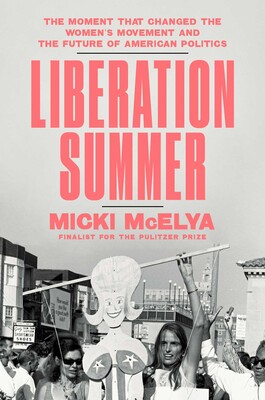
Professor McElya’s 2026 book Liberation Summer is about a key moment in the women’s liberation movement surrounding the 1968 Miss America pageant in Atlantic City and the reactions and protests it was surrounded by.
Professor McElya’s 2026 book Liberation Summer, about a key moment in the women’s liberation movement surrounding the 1968 Miss America pageant and the reactions and protests it was surrounded by, has been widely recommended by the New York Times, the Boston Globe and Kirk’s reviews. Her last book about the history of Arlington National Cemetery was a finalist for the Pulitzer.
The University of Connecticut History Department is pleased to announce that the Fall 2026 Draper Workshop will take place on November 16th, from 4:30 – 6:00 PM in Herbst Hall rm. 1o1, with a reception to follow. The event will focus on the 250th anniversary of the American Revolution, and will feature a panel discussion from professors Maya Jasanoff (Harvard University), Robert Parkinson (Binghamton University), Mark Peterson (Yale University), Karin Wulf (Brown University), and Andy Horowitz (University of Connecticut). Prof. Manisha Sinha (University of Connecticut) will moderate.