Archives

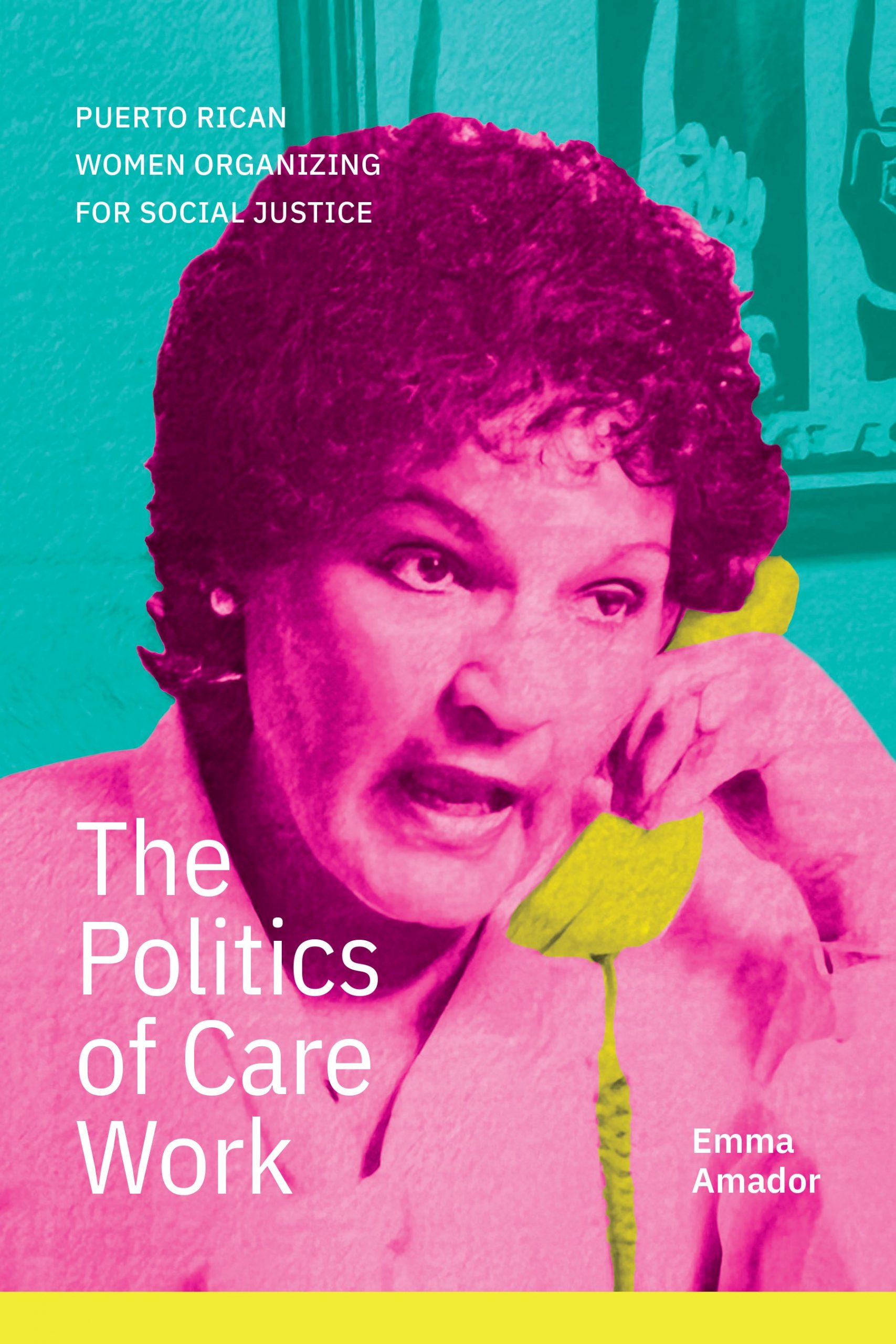
The Politics of Care Work

Emma Amador, Author

Duke University Press, 2025


In The Politics of Care Work, Emma Amador tells the story of Puerto Rican women’s involvement in political activism for social and economic justice in Puerto Rico and the United States throughout the twentieth century. Amador focuses on the experiences and contributions of Puerto Rican social workers, care workers, and caregivers who fought for the compensation of reproductive labor in society and the establishment of social welfare programs. These activists believed conflicts over social reproduction and care work were themselves high-stakes class struggles for women, migrants, and people of color. In Puerto Rico, they organized for women’s rights, socialism, labor standards, and Puerto Rican independence. They continued this work in the United States by advocating for migrant rights, participating in the civil rights movement, and joining Puerto Rican-led social movements. Amador shows how their relentless efforts gradually shifted the field of social work toward social justice and community-centered activism. The profound and enduring impact of their efforts on Puerto Rican communities underscores the crucial role of Puerto Rican women’s caregiving labor and activism in building and sustaining migrant communities.

Black Movement: African American Urban History since the Great Migration

Jeffrey O. G. Ogbar, Editor

The University of North Carolina Press, 2025


Description:

The Great Migration of African Americans from the South to northern and western cities between 1915 and 1970 fundamentally altered the political, social, and cultural landscapes of major urban centers like New York, Chicago, Philadelphia, and Detroit, and changed the country as well. By the late twentieth century, Black people were mayors, police chiefs, and school superintendents, often at parity and sometimes overrepresented in municipal jobs in these and other cities, which were also hubs for Black literature, music, film, and politics.

Since the 1970s, migration patterns have significantly shifted away from the major sites of the Great Migration, where some iconic Black communities have been replaced by mostly non-Black residents. Although many books have examined Black urban experiences in America, this is the first written by historians focusing on the post–Great Migration era. It is centered on numerous facets of Black life, including popular culture, policing, suburbanization, and political organizing across multiple cities. In this landmark volume, Jeffrey O. G. Ogbar and his contributors explore the last half century of African American urban history, covering a landscape transformed since the end of the Great Migration and demonstrating how cities remain dynamic into the twenty-first century.

Contributors are Stefan M. Bradley, Scot Brown, Tatiana M. F. Cruz, Tom Adam Davies, LaShawn Harris, Maurice J. Hobson, Shannon King, Melanie D. Newport, Jeffrey O. G. Ogbar, Brian Purnell, J. T. Roane, Chanelle Rose, Benjamin H. Saracco, and Fiona Vernal.

Primo Levi e i suoi compagni

Sergio Luzzatto, Author


Donzelli Editore, 2024

Book cover of Professor Sergio Luzzatto's book "Primo Levi e i suoi compagni"

Description:

You who live safe/ In your warm houses … Meditate that this came about:/ I commend these words to you”: with unforgettable verses, of Dantesque proportions, Survival in Auschwitzopens, a text that has become over time the definitive book on Auschwitz, on the horror of the twentieth century. But what does Primo Levi mean when he says “you”? What, when he says “I”? And what, when he says “we”? The way in which the author, a master of the Italian language, has strategically employed – and bent – ​​personal pronouns nests the tangle of good and evil, of innocence and shame in the Shoah: the idea, at once, of belonging and of distance, but also the pain of guilt, and the responsibility that derives from it. Starting from these questions, Sergio Luzzatto returns to examine the figure of Primo Levi and reconstruct the story behind his writing, following the path that from leads the characters of Survival in Auschwitzto the real identity of his deportation companions, the European Jews forced “to the bottom” with him. Who were the members of the chemical Kommando of Auschwitz-Monowitz? And who were, in particular, the companions represented by Levi as negative or even abject characters, Luciferian incarnations of evil? Perhaps Primo Levi would have become a writer even if he had not been deported to Auschwitz. Certainly he would have been a different writer, if the history of the twentieth century had not marked the life of the young chemist forever through the experience of that black hole. That is why his books today must be reread today with the tools of historians: to unravel the threads of a continuous – and problematic – fabric, between historical fact and literary transfiguration.